
Bench Warrants in Howard County
A bench warrant is the practical court term for an order to bring a person before the court after nonappearance or noncompliance. Common Howard County triggers include a willful failure to appear on a citation, a missed criminal hearing or sentencing, violation of an order, and contempt proceedings.
Unpaid court debt can cause collections and license or registration consequences, but official sources do not say every unpaid fine automatically creates a warrant. Family and juvenile matters can follow specialized or confidential procedures.
How a Howard County Bench Warrant Is Issued
For a missed citation appearance, Iowa Code section 805.5 authorizes an arrest warrant for willful failure to appear. The clerk records the transfer and returns the warrant and citation to the issuing agency for enforcement.
The lifecycle is missed obligation, judicial issuance, clerk docket and agency transfer, service or surrender, return and initial appearance, then recall, quash, or continued proceedings.
Howard County Bench Warrants Use District Court
Howard County does not have a separate municipal-court or justice-of-the-peace warrant docket. District judges, district associate judges, and judicial magistrates work inside the unified Iowa District Court. A magistrate handles scheduled traffic matters, simple misdemeanors, and municipal or county infractions. A district associate judge has broader misdemeanor and Class D felony authority. A district judge has general trial jurisdiction.
This structure changes the search route. A missed Cresco traffic setting or a magistrate-level matter is still checked through Iowa Courts Online and the Howard County Clerk, not through a city warrant portal. The clerk at (563) 547-9206 can identify the public docket, judicial officer, next setting, and recorded warrant event. Court staff cannot choose a legal motion or give advice.
Howard County is part of Judicial District 1. A public case search may describe a bench warrant through a sequence of events rather than a single status field. Useful terms include failure to appear, warrant issued, officer return, initial appearance, recalled, and quashed. The sequence matters because a returned warrant and a recalled warrant describe different actions. If the latest line is unclear, ask the clerk to explain what the public record states and whether a future appearance remains scheduled.
Juvenile matters are different. Iowa Code chapter 232 generally protects juvenile records, so the ordinary adult docket route may not reveal a juvenile order. The Juvenile Court Office, rather than a broad public name search, is the appropriate administrative contact for access questions. Confidentiality is another reason not to treat a missing public result as proof that no court order exists.
Howard County Bench Warrant vs Arrest Warrant
A probable-cause arrest warrant starts with a sworn complaint or affidavit alleging an offense. A bench or FTA warrant responds to a missed obligation in a court matter. Iowa's section 805.5 calls the citation-based FTA document an arrest warrant, so the actual docket label controls.
| Feature | Bench Warrant | Arrest Warrant |
|---|---|---|
| Trigger | Missed date, FTA, or noncompliance | Probable cause for an offense |
| Who Issues It | Judicial officer in the pending case | Magistrate or judge on complaint or affidavit |
| Underlying Case | Existing court obligation | Criminal complaint or charged offense |
| How It Clears | Appearance, recall, or quash | Arrest or surrender, initial appearance, and bond order |
Howard County Bench Warrant Bond Limits
The Iowa uniform bond schedule applies only in defined circumstances when court is not in session. It does not promise a particular outcome for a Howard County bench warrant. A judicial officer may set different terms, and specified serious charges require judicial review.
The published schedule lists $25,000 for a Class B felony, $10,000 for Class C, $5,000 for Class D, $2,000 for an aggravated misdemeanor, $1,000 for a serious misdemeanor, and $300 for a simple misdemeanor. Traffic matters use the compendium amount. Those figures describe a statewide schedule, not any person's warrant.
The official schedule image shows the source and its conditions.
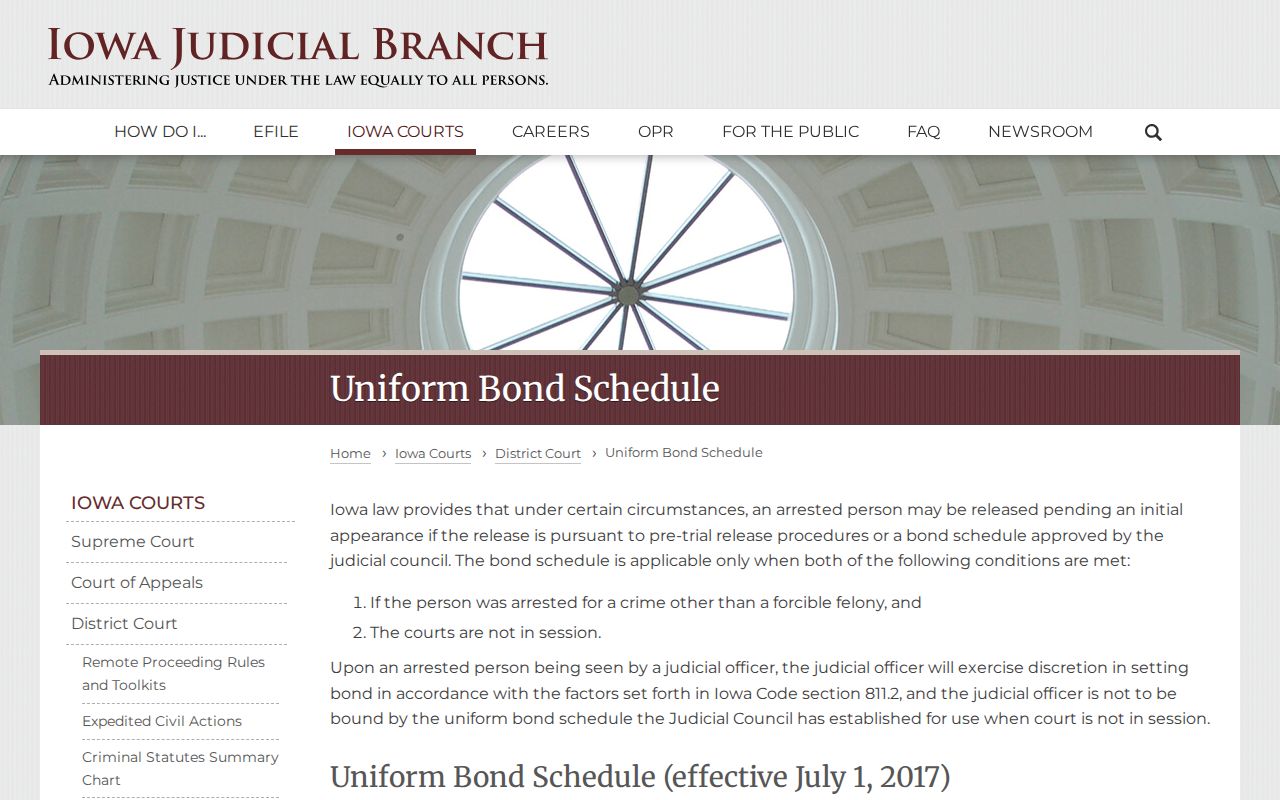
Call the Clerk and Sheriff for the actual order, bond type, payment place, and current instructions before relying on a schedule amount.
How to Resolve a Howard County Bench Warrant
No Howard County walk-in bench-warrant day, recall form, surrender sheet, online bond portal, standard filing fee, or guaranteed release process was located. The safe route begins by confirming the order and ends by checking both the court docket and agency record.
- Search Iowa Courts Online and call the Howard County Clerk to confirm the warrant, case number, judicial officer, reason, and next setting.
- Consult an Iowa attorney about a motion, new date, attorney appearance, bond, or arranged surrender.
- If surrender is directed, call the Sheriff at (563) 547-3535 before visiting the Law Enforcement Center.
- Complete the required appearance, filing, payment, or bond step, then obtain the court order or docket confirmation.
- Ask the Sheriff to confirm that the law-enforcement record reflects the court's recall, quash, service, or other disposition.
Caution: Paying a balance does not necessarily recall a Howard County bench warrant or cancel the required court appearance.
The Howard County Bench Warrant Agency Layer
The Iowa On-line Warrants and Articles Criminal Justice Information Network connects authorized law-enforcement and criminal-justice users with wanted-person information and NCIC. It is not a public statewide warrant search. Members of the public cannot use it as an alternate name lookup when the court docket is unclear.
The Iowa Department of Public Safety system page explains the agency network.
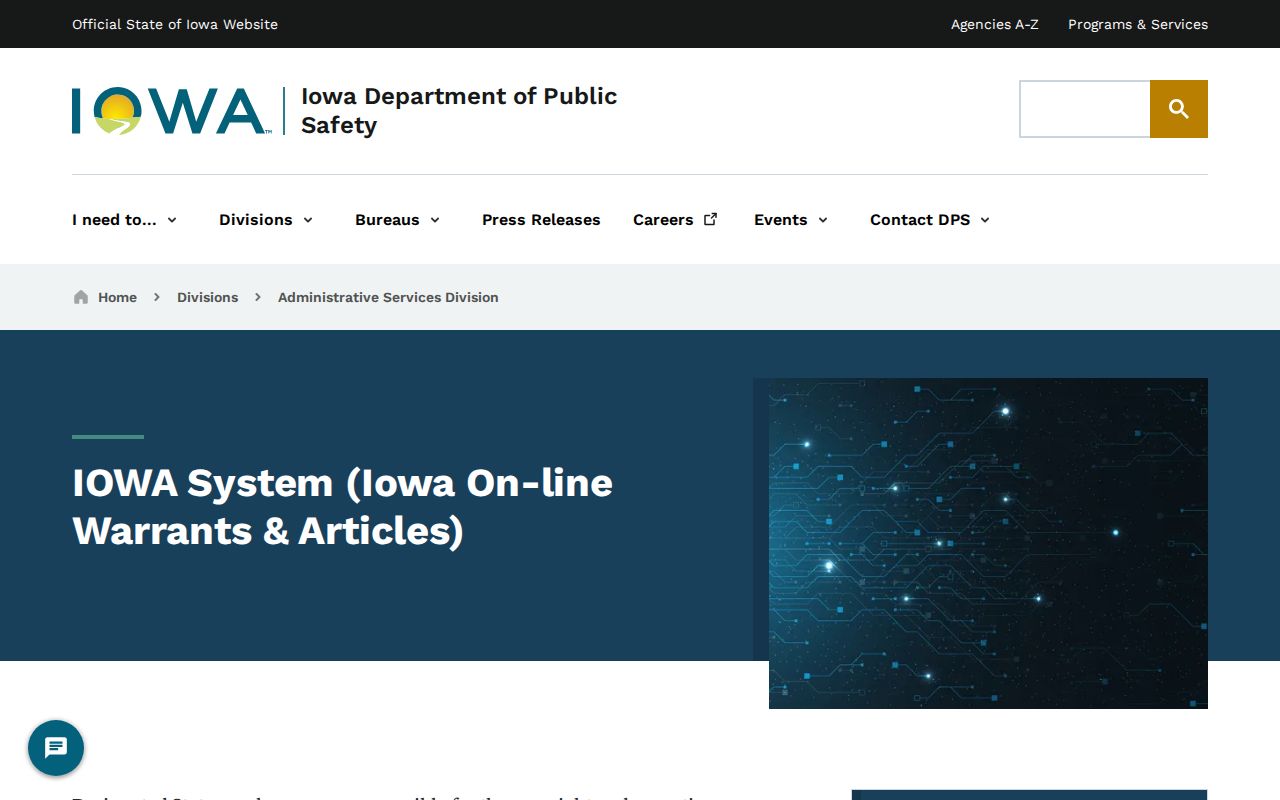
The public fallback remains the Howard County Clerk for court status and the Sheriff for law-enforcement confirmation. A blank public result cannot substitute for that two-part check.
Which Court Issued the Howard County Bench Warrant
The Iowa District Court for Howard County is the trial court, but different judicial officers handle different case types. A district judge may handle felony and broad criminal matters. A district associate judge can handle serious and aggravated misdemeanors and Class D felonies. A judicial magistrate can handle traffic, scheduled violations, simple misdemeanors, municipal and county infractions, and initial appearances.
The issuing judicial officer controls a recall, quash, new setting, appearance, and case order. The Howard County Clerk at 137 North Elm Street in Cresco is the common public route for these levels. Juvenile Court records are generally confidential, so they do not follow the ordinary adult public-search path. The Sheriff serves or maintains agency status but does not replace the issuing court's order.
Howard County Bench Warrant Surrender Calls
The Law Enforcement Center at 124 South Park Place is separate from the courthouse. Its public page describes detention and possible release through bail, pretrial services, probation supervision, or personal recognizance. It does not publish a warrant surrender window, public bond-counter hours, accepted payment methods, or guaranteed release time.
Posted jail visiting hours are not surrender or bond hours. First obtain the current court information from the Clerk. Then call the Sheriff and ask where and when to report, what identification or case number is needed, how bond is set, and when the court record should update. An attorney can help coordinate the process and explain the underlying charge.
Howard County Bench Warrant Payment Scams
The Iowa Judicial Branch warned in June 2026 about calls, texts, and letters claiming missed jury service, unpaid fines, or arrest warrants. Courts do not demand Social Security numbers, prepaid cards, bitcoin, or an immediate transfer through a special phone number. Law enforcement does not collect court fines by threatening a caller.
The official scam warning directs residents to Iowa Courts Online, the clerk, and the official payment line.
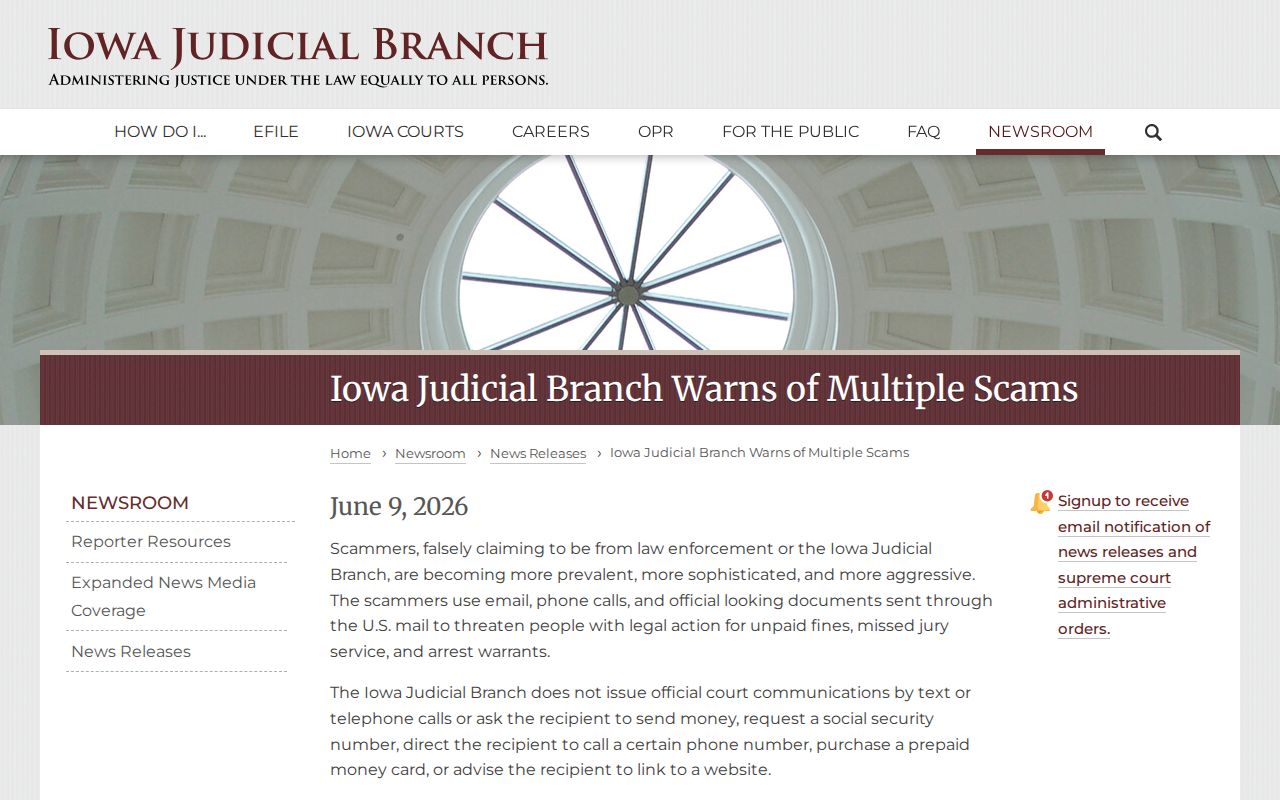
Use known government addresses and numbers. Keep any payment receipt, court order, and new hearing date, then confirm that the warrant event changed on the docket.